Sample clarification desk
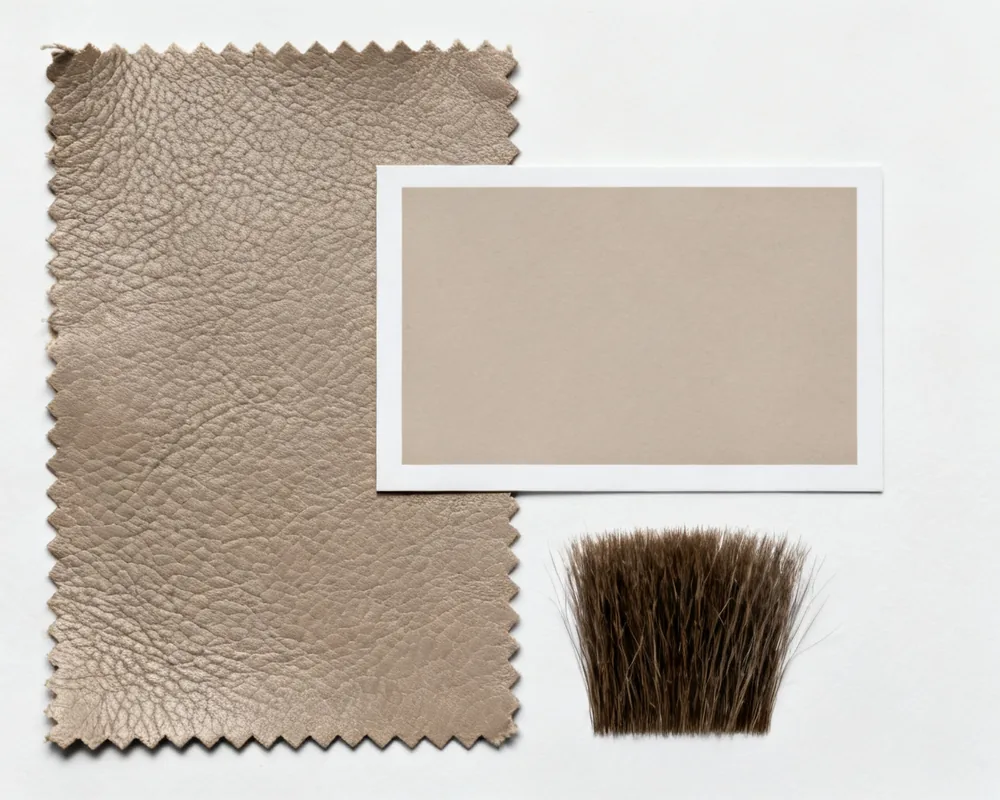
Describe the difference
- What should stay the same on the face, the backing, or the fiber chemistry?
- Which finish, bond or linear-density property needs another look?
- How will the next sample be assessed, and against which dated piece?
A useful clarification starts by naming the family. Synthetic leather and coated fabrics are reviewed through surface finish, backing and bonding compatibility. Yarns, fibers and threads, including a kuraray pva fiber question, are reviewed through chemistry, linear density and the supply format in the brief. Mixing those vocabularies makes the approval note ambiguous, because a grain comment cannot be checked on a loose fiber and a denier comment cannot be checked on a finished surface.
Write the property that must remain stable before you write the property that should change. For a surface, stability might mean the backing cloth and the bond line, while the change might be gloss, emboss depth or flex. For a fiber, stability might mean the polymer identity, while the change might be cut length or the way the package is identified. Handfeel, durability and processing compatibility move together when construction or finishing changes, so name the acceptance criteria in the same note rather than leaving them as a general request for something softer or stronger.
Compare a dated reference specimen with the proposed description. Record appearance, handle or construction only for the criteria that belong to that specimen. If the reference is a previous surface cutting, say which face was approved and whether the backing was visible. If the reference is a fiber card, say which package it came from. A request to see a sample does not mean a cutting is available, and it does not mean a later bulk lot will match the cutting.
When a phrase such as kuraray clarino bio-based synthetic leather appears in the brief, treat it as a material name to verify, not as a completed environmental statement. Ask which finish record, which bio-based content wording and which product scope accompany that name. Do not transfer a document from one surface grade to another, and do not attach a fiber certificate to a coated construction because the brand name is shared.
Coating and lamination are not interchangeable labels for the same surface. A coated substrate is reviewed through coating add-on, adhesion and the softness that remains after the add-on. A laminated construction is reviewed through the film, peel behaviour and the state of the specimen. If the cutting does not show which build it is, the note says unknown. Stock and custom development stay apart in the same way. A stock question needs the inventory date, the shade batch and whether the next delivery can continue that batch. A custom question needs the sample, the trial and the bulk approval step. Neither path is confirmed by sending this form.
Handfeel and abrasion resistance can move in opposite directions. A face adjusted for a drier, tougher touch may lose the handle the designer wanted, and a softer face may show wear sooner. Record the acceptance limit for each, including the method name, rather than asking for a single word such as durable. Colorfastness, seam slippage, tear strength and dimensional stability can be named as open limits. Mass still belongs in g/m², usable width in cm, composition as percent by mass adding to 100, and fiber linear density in dtex or denier, where 1 denier is about 1.11 dtex. A conditioning line should say whether the specimen was held at 20 °C and 65% relative humidity.
When the reference is incomplete
State the missing item. If the backing is unknown, say so. If the fiber supply format is unknown, say so. Do not fill the gap by assuming a laminate, a roll length or a stock position. The next handoff should list the open points beside quantity and destination, so order context stays separate from the material comparison.